
North Platte City Directory Collections
North Platte does not have one verified, continuous city-directory run published by its official library pages. The documented trail starts with a 1907 directory reference and a 1907–08 Lincoln County pointer, then reaches selected North Platte years in digitized and cataloged collections. That distinction matters. A missing result can mean the collection lacks that year, the scan is not indexed, or the name was printed differently. Start with the documented years below, record the collection and page, then ask for local holdings that are not listed online.
| Collection | Years | Where Held | Access |
|---|---|---|---|
| North Platte / Lincoln County directory pointers | 1907–1908 | North Platte genealogy listing and Lincoln County listing | Online finding aid; publisher and full run not stated |
| U.S. City and Business Directories | 1921, 1929, 1932 pointers | FamilySearch collection | Search by place and year when scans are available |
| MyHeritage North Platte entries | 1929, 1932, 1947, 1956, 1958, 1960 | Established genealogy collection listing | May require an account or library access |
| Polk's North Platte volume | 1950, 1954, 1986 examples | Digitized research PDF and 1986 catalog record | Use cited pages or catalog evidence; a complete scan was not inspected |
Reverse or criss-cross directory years for North Platte were not published in the sources reviewed. The appropriate next step is to ask the North Platte Public Library research desk for its local-history inventory, including reverse books, telephone directories, yearbooks, newspaper microfilm, and obituary files. Note: A documented pointer identifies a year worth testing, not proof that every household or page survives online.
North Platte City Directory Years to Test
The best first searches have specific year anchors. A History Nebraska study places Richi Ugai in the 1907 North Platte city directory as a porter at the Union Pacific Hotel and living there. Polk evidence identifies Wilford Samuel as a pharmacist at Davis Pharmacy, with wife Cath M., in citations to the 1950 and 1954 editions. Those examples show why a volume should be read as a compact record with several separate clues, rather than as a simple name match.
- 1907: test a surname, hotel, business, or Union Pacific connection against the earliest identified North Platte reference.
- 1907–08: check the North Platte and Lincoln County pointers before assuming a household was absent.
- 1921, 1929, and 1932: search the FamilySearch U.S. City and Business Directories collection by city and year.
- 1947 through 1960: test the listed MyHeritage pointers, using initials and married or widowed names when needed.
- 1950, 1954, and 1986: use the documented Polk references as separate checks, not as evidence of an unbroken Polk run.
The first North Platte directory publisher and the last printed year were not located. That gap is worth preserving in research notes. It avoids turning examples from 1907, 1950, 1954, and 1986 into an invented publishing history.
North Platte Library Routes for Historical Volumes
The North Platte Public Library catalog and research portal is the local fallback when a scanned directory or index does not answer the question. Its public pages point to Horizon/Enterprise, databases, and electronic resources, but do not state exact directory, reverse-directory, obituary-index, or yearbook runs. A focused request can ask staff to check a surname, an address, a date range, and the local-history formats most likely to hold it.
The library research catalog and databases page provides the official route to the catalog, digital resources, and staff-assisted research options.
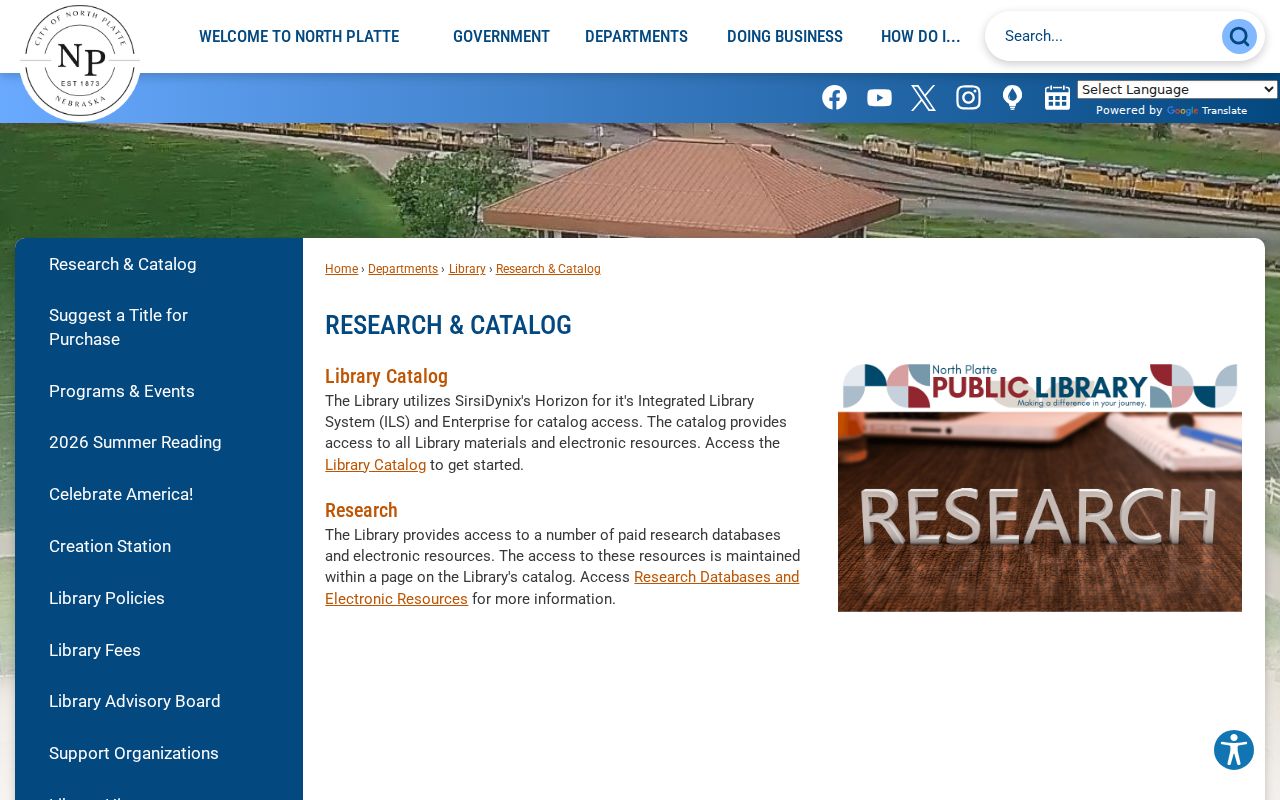
The library is at 120 W 4th Street and lists 308-535-8036. Its building hours include Monday, Wednesday, Friday, and Saturday 9–6, Tuesday and Thursday 9–8, with Sunday closed. The catalog and electronic resources remain available around the clock. The published research-service schedule gives the first 30 minutes free, then $20 per hour prorated, with a $50 rush charge for work requested in under three business days.
Reading a North Platte City Directory Entry
Copy the line exactly before interpreting it. The research evidence shows older North Platte entries can combine a name, occupation, workplace, and residence, while a later Polk citation can identify a spouse and business. An entry may refer to a hotel or boarding address instead of a private street. Initials, an alternate spelling, or a business address can be the key to finding the same person in another record.
| Name | Transcribe surname, given name, initials, and any cross-reference exactly as printed. |
|---|---|
| Spouse or household notation | Record a spouse in parentheses, a widow notation, or boarding-house wording without assuming a modern household relationship. |
| Occupation and employer | Capture both. Ugai's 1907 porter and Union Pacific Hotel details are stronger together than either alone. |
| Residence or business address | Keep the house number, street, hotel, or business location separate from any other address on the line. |
| Owner or renter mark | Copy it only if printed. The exact abbreviation key for a North Platte run was not located. |
- Criss-cross directory
- An address-ordered directory that can lead from a street to the historical occupants or businesses listed there. The exact North Platte run must be confirmed with the library.
- Householder index
- A name-oriented part of a volume that identifies people or households, often separately from the street-order material.
- Abbreviation key
- The volume's explanation of shorthand. Photograph or copy it before expanding symbols for residence, widowhood, or ownership.
North Platte City Directories and Railroad Addresses
North Platte's railroad history changes how old resident entries should be read. Bailey Yard and the Union Pacific setting produced hotel, boarding-house, business, union, cemetery, and newspaper clues that may appear beside a name. In the 1907 Ugai example, the workplace and residence were both the Union Pacific Hotel. That is evidence of an address context, not a reason to assume a modern-style private household.
For an early downtown clue, preserve the business and street terms as search anchors. The Original Town Business Historic District lies between A Street, Front Street, Vine, and Chestnut, and the original plat dates to 1867. A 2026 historic survey agenda supplies dates for the Elks, IOOF hall, Masonic Temple, and Keith Theatre that can be paired with a name or nearby block in the newspaper archive.
Trace North Platte City Directory Households
A historical volume can help reconnect an heir, a former classmate, or a family branch, but it should be paired with records that explain the change. A disappearance may reflect a move, marriage, death, boarding arrangement, a changed spelling, or a missing volume. Do not turn a property owner or a mailing address into proof that someone lived at a place. Follow the printed details through the closest available sources.
- Begin with a known person, address, and approximate year, then search the relevant city-directory collection.
- Copy the entry's initials, spouse notation, occupation, employer, residence or business address, and printed abbreviation.
- Compare adjacent directory years for moves, widowhood, marriage, a boarding address, and any owner or renter notation.
- Pair 1900 through 1970 census years with the nearest city-directory year, observing the federal 72-year release rule for later census images.
- Use notices, cemetery entries, vital records, probate, or deeds to explain an apparent disappearance or address change.
- Record the collection, year, and page. A secondary transcription is a lead, not a replacement for the original scan.
When the trail reaches a current street or parcel question, the modern address-record process belongs with the North Platte street directory. Its parcel and deed route is different from reading historical volumes.
North Platte Newspapers After a Directory Gap
Directory years leave gaps, and the Advantage Archives advanced search can bridge them with people, places, events, title, city, and date controls. The archive lists Lincoln County Tribune from 1884–1946 and North Platte Daily Telegraph Bulletin from 1900–1936, among many title changes. Search the same person, business, hotel, lodge, theater, or street across different newspaper titles because a single city name search can miss the relevant publication.
Newspaper material can clarify an occupation, business move, obituary, meeting, or address reference. It is still a separate record genre. Compare its date and wording with that directory volume instead of silently merging the two into one statement about a person.
Note: The archive's title coverage overlaps in places, so confirm the displayed title and date before citing a result.
North Platte Archives and Historical Volumes
History Nebraska's James E. Potter Research Room supplies an additional route for maps, newspapers, books, manuscripts, government records, church and cemetery resources, and research guides. The library's published hours include Monday by appointment and Wednesday through Friday 9–4, so current access details should be confirmed before a visit. Its online materials include plats and atlases from 1885 onward, the Gazetteer Index for 1890 and 1911, and statewide research aids.
Lincoln County RG218 contains records dated 1866–1981, including assessor, clerk, Register of Deeds, county court, district court, and school materials. The collection totals 52.5 cubic feet, 259 volumes, 11 boxes, and 34 microfilm reels. The archive description notes a missing Probate Docket 155 from 1965. Record that gap and use surrounding docket numbers, newspapers, deeds, cemetery material, or successor estate records rather than guessing what the missing docket said.
Careful North Platte Directory Use
These volumes are especially useful for family history because they create dates between censuses. They do not confirm every person at an address, and a printed address may be a workplace, hotel, boarding place, or mailing location. The strongest result keeps the original entry, tests a name variant, and corroborates the finding with a census, newspaper, cemetery record, probate file, deed, or official custodian.
Use historical address information for lawful personal research and do not use it to harass, threaten, surveil, or expose a protected person. Nebraska protects certain addresses and records, including address-confidentiality participants, protected voter records, and sealed court material. For current confidentiality information, consult the Nebraska Address Confidentiality Program.